

Non-Repainting, and Why It's Non-Negotiable
A repainting indicator rewrites its own history. The arrow that looks perfect on the chart today was not there in real time — it was painted in after the fact, once the outcome was already known. Backtest a strategy on a repainting signal and you are measuring hindsight, not edge. Every Probalist script is built so this cannot happen. Here is what that means and why it is the foundation everything else stands on.
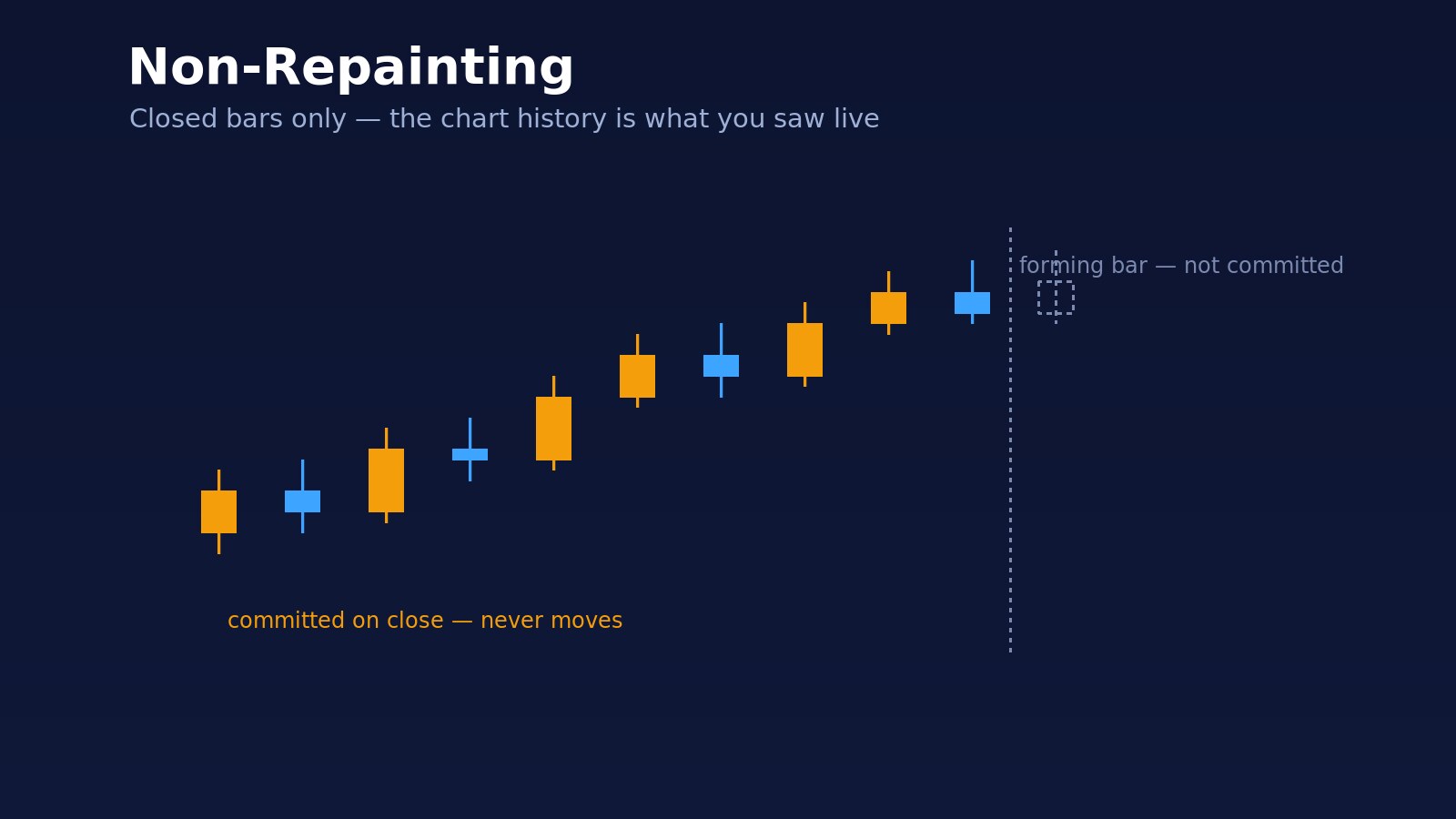
The Repainting Trap
Repainting is when an indicator changes values it already printed. The classic culprit is a signal that depends on the current bar before that bar has closed. While the candle is still forming, price moves, and the indicator flickers — an arrow appears, vanishes, reappears one bar later in a better spot.
Scroll back through history and you only ever see the final version: the arrows that survived. They look uncannily well-timed because they were placed with information that did not exist when the bar was live. That is the trap. A repainting backtest does not show you how the tool performed; it shows you a polished story of what you would have caught if you could see the future.
Closed Bars Only
Probalist's hard rule is simple: a signal is decided on closed bars only. Nothing is committed while a candle is still forming. In Pine terms, the logic is gated on barstate.isconfirmed — the bar must be finished before the indicator will judge it.
The practical consequence: what you see in the chart history is exactly what you would have seen live, bar for bar. There is no version of the past that is better than the version you traded. When the bell curve or a Wilson-backed glyph tells you a signal had an edge, that statistic was computed on the same closed-bar signals you actually could have taken — not on a hindsight-flattered set.
The [1] Rule for Higher Timeframes
Multi-timeframe features are where most indicators quietly start repainting. Pulling the current daily level onto a 1-hour chart leaks future information: the daily bar is still forming, so its value keeps changing through the day.
Probalist scripts request higher-timeframe data from the confirmed prior bar (the [1] offset) with lookahead turned off. You get the last settled higher-timeframe value, never a half-formed one. That is why the multi-timeframe confluence badge (✦) is trustworthy: when it says a higher timeframe agrees, it is comparing against a level that was actually locked in, not one that will be revised by the close.
What Honesty Costs You
Non-repainting is not free, and pretending otherwise would be its own kind of dishonesty. Because a signal is only judged once the bar closes, there is a confirmation lag — you find out on the next bar, not mid-candle. A repainting indicator feels faster precisely because it is cheating.
Probalist scripts make that lag explicit rather than hiding it. A developing swing leg is drawn dashed until it confirms; the confirmation delay is spelled out instead of glossed over. You trade slightly later, but you trade on something real. That trade-off — a bar of lag in exchange for statistics you can trust — is the whole bargain.
Verify It Yourself
You do not have to take this on faith. Two quick checks:
- Bar Replay. Use TradingView's bar-replay to step forward one candle at a time. A non-repainting signal locks in place the moment its bar closes and never moves again. A repainting one shifts as you advance.
- Reload. Note where a recent signal sits, refresh the chart, and look again. If it jumped, it repainted.
Because the full Pine Script of every Essentials indicator is open source on its TradingView page, you can also read the gating logic directly — the barstate.isconfirmed checks and the [1] higher-timeframe requests are right there.